In developing the Network and forming our ideas, we will have access to good source documents, such as those from the ESPAS network – the European Strategy and Policy Analysis System – which is currently carrying out an extensive exercise into 2030 global trends with regard to the challenges facing the European Union. For all the latest documents please visit the Open Repository Base on International Strategic Studies (ORBIS) webpage. With over 1,000 documents, this brings the world’s largest library of prospective studies to your fingertips. Discover the long-term trends that will shape society.
Below are a selection of key documents from multiple sources.
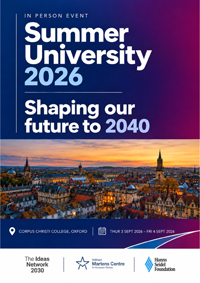
September 2026 - IN2030 Summer University final report
On 3 and 4 September 2026, the Ideas Network 2030 brought speakers, policymakers and delegates together at Corpus Christi College, Oxford, for its Summer University - two days set deliberately apart from the news cycle to ask a harder question: what will the world look like by 2040, and what should the centre right do about it. The final report sets out, session by session, the arguments made, the disagreements surfaced in discussion, and the ideas participants judged most worth carrying forward - offered as a foundation for the network's ongoing work toward a Vision 2040 agenda.
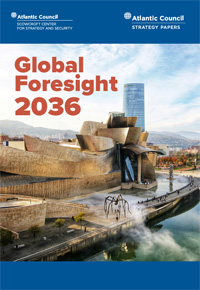
2026 - Atlantic Council - Global Foresight 2036
Global Foresight is an annual strategic foresight series produced by the Atlantic Council’s Scowcroft Center for Strategy and Security. The series aims to generate original and provocative insights about the world and its future. Although it is impossible to predict with certainty how the years ahead will unfold, it is useful to develop a deeper understanding of how trends and uncertainties—drivers of change—might shape the future. Global Foresight is designed to assist in identifying and comprehending these driving forces today and what the consequences of that change—both positive and negative—might be for the world writ large over the coming decade
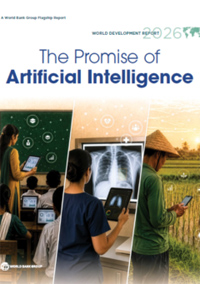
August 2026 - The Promise of Artificial Intelligence - World Development Report
In a time when development progress has dipped to its weakest pace in 75 years, artificial intelligence (AI) offers developing economies a rare path to greater prosperity. World Development Report 2026 provides the first comprehensive assessment of what AI means for these economies—how firms and governments are already using it, what is holding them back, where the largest gains may lie, and how the risks can be managed. Its central message is both practical and ambitious.
June 2026 - Implementing the Drahi Report: the Moment of Truth (Institut Montaigne)
Mario Draghi’s landmark report on the future of European competitiveness sent shockwaves across Europe in the summer of 2024. It offered a stark assessment of a continent falling behind in economic performance and productivity in the face of a rising China and a more assertive United States. Against the backdrop of the accelerating erosion of the post–Cold War, rules based international order—already declared “defunct” by Draghi—economic dependencies are increasingly being weaponized for geopolitical ends. At stake is not only European prosperity but also our very freedoms.
June 2026 - The OECD‑FAO Agricultural Outlook 2026‑2035
The OECD‑FAO Agricultural Outlook 2026‑2035 assesses ten-year prospects for agricultural commodities and aquatic food markets at global, regional and national levels.
April 2026 - World Economic Outlook (International Monetary Fund)
The World Economic Outlook (WEO) is a survey of prospects and policies by the IMF staff, usually published twice a year, with updates in between. It presents analyses and projections of the world economy in the near and medium term, which are integral elements of the IMF’s surveillance of economic developments and policies in its member countries and of the global economic system. They consider issues affecting advanced, emerging and developing economies, and address topics of pressing current interest.
February 2026 - Prospects for 2026 - What others are saying
This publication complements the Forward Look 2026 by bringing together key global trends identified by external experts. Drawing on 35 outlook reports from diverse international sources, it explores developments across society, technology, economy, environment, and (geo-)politics, and highlights the ten conflicts expected to shape 2026.
January 2026 - Global Economic Prospects (World Bank Group)
The global economy has shown notable resilience to heightened trade tensions and policy uncertainty. Last year’s faster-than-expected pace of growth capped a recovery from the 2020 recession unmatched in six decades, even if vulnerable emerging market and developing economies are lagging behind. This year, global growth is projected to edge down, in part as firms scale back inventory accumulation and tariff effects intensify. Growth could falter further if trade tensions escalate or financial market sentiment deteriorates.
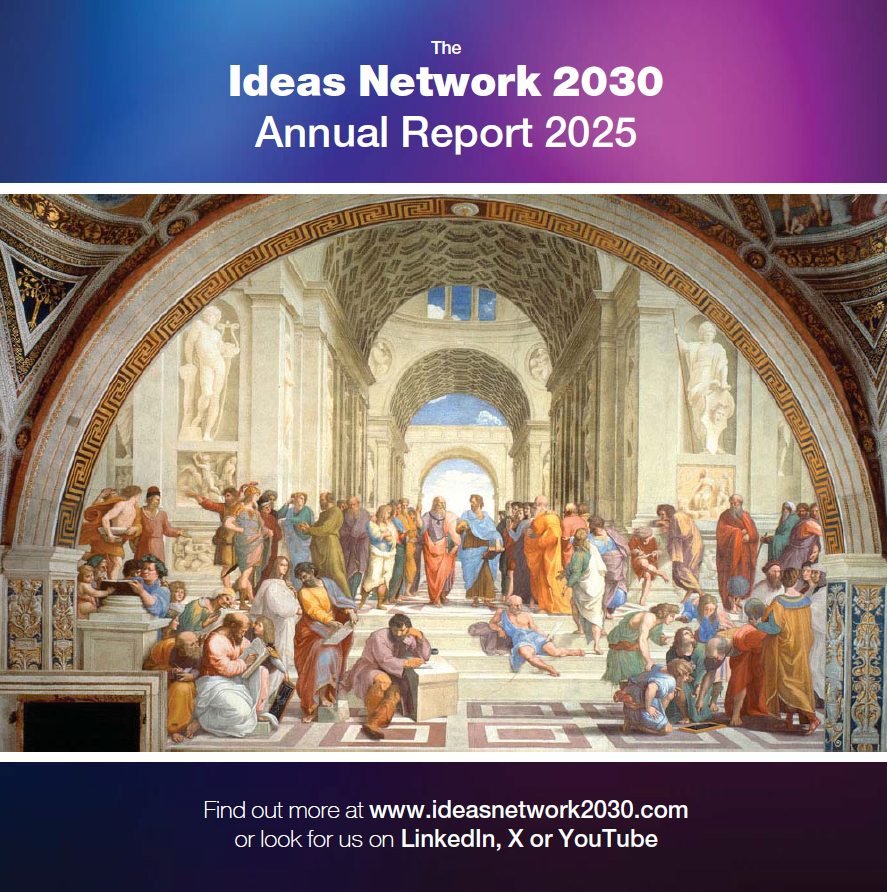
2026 - Ideas Network 2030 Annual Report
The report covers the activity of the Network during 2025 including comprehensive summaries of each event held during the year.
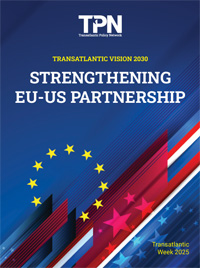
2025 - Transatlantic Vision 2030 - Strengthening EU-US partnership
The Transatlantic Policy Network has continued to develop its ideas and policy proposals. It has prepared this report outlining recommendations for strengthening transatlantic partnership looking toward 2030 and beyond. These recommendations are founded on the belief that there are fundamental geostrategic and geoeconomic challenges to be met together as well as specific issues where both the EU and the US will benefit through collaboration rather than individual actions.
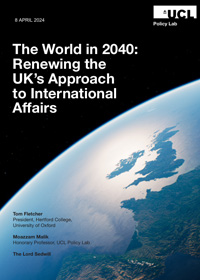
April 2024 - The World in 2040: Renewing the UK's approach to international affairs
As the country heads towards a crucial general election, a new publication from UCL Policy Lab and Hertford College, Oxford, sees leading figures from British diplomacy and international development, including the former Cabinet Secretary Lord Mark Sedwill, call for a renewed vision of UK foreign affairs. Following a series of in-depth roundtable discussions, led by UCL Honorary Professor and former Director General at the Foreign, Commonwealth and Development Office, Moazzam Malik, the report sets out a series of measures to renew and reform the UK foreign affairs function.
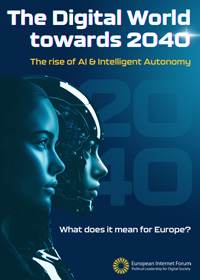
2024 - The Digital World towards 2040
The widespread adoption of generative AI presents both opportunities and challenges for legislators. The rate of technology adoption will only increase in the age of AI. The issues at hand are well-known: fostering innovation, securing employment, and overhauling education, among others. What has shifted, however, is the magnitude, speed of change, and concurrent impact across various domains. In this report, we see generative AI as one of the founding technologies on the road to Artificial General Intelligence (AGI).
April 2024
This fourth ESPAS Global Trends Report is a contribution to the ongoing debate about the future of Europe, its role in the world and its ability to adapt and change to meet fresh challenges and harness new opportunities. In common with other foresight studies, this report does not predict the future. Rather, it attempts to identify the key global trends, analyse their significance for Europe, assess the agency the European Union has to influence global thinking, and sets out some of the main strategic choices policymakers may be required to make — choices that will have a strong bearing on the kind of Europe we will live in by 2040.
July 2024 - The 7Ds for Sustainability – 175 proposals for the next legislature
The European Parliament faces a crucial task in shaping the future of Europe’s defence. The European
defence technological and industrial base must be strengthened to address both geopolitical and internal
EU challenges. This requires a geostrategic, evidence-based approach, substantial financial resources,
and a commitment to integrating new partners and contributing to the defence of Europe. The European
Defence Industrial Strategy (EDIS) and the European Defence Investment Programme (EDIP) represent
the EU’s consolidated response to the evolving geopolitical dynamics. The framework needs to be
adapted to strengthen the European defence technological and industrial base, balance national and EU
efforts, and respond to the rapidly evolving geopolitical landscape.
March 2021 - Global trends report
Published every four years since 1997, Global Trends assesses the key trends and uncertainties that will shape the strategic environment for the United States during the next two decades. Global Trends is designed to provide an analytic framework for policymakers early in each administration as they craft national security strategy and navigate an uncertain future. The goal is not to offer a specific prediction of the world in 2040; instead, the intent is to help policymakers and citizens see what may lie beyond the horizon and prepare for an array of possible futures.
September 2019
Published by the Ideas Network 2030, the IN2030 Future Programme: shaping our future through the generation of imaginative ideas focuses on the key global trends to 2030. The document analyses five key trends; security, migration and demography, digital change, sustainable development, plus trade and economics.

2012
Published in 2012, Global Trends 2030: Alternative Worlds is the fifth installment in the National Intelligence Council’s series aimed at providing a framework for thinking about the future. As with previous editions, the report was aimed at stimulating strategic thinking by identifying critical trends and potential discontinuities. It distinguishes between megatrends, those factors that will likely occur under any scenario, and game-changers, critical variables whose trajectories are far less certain.