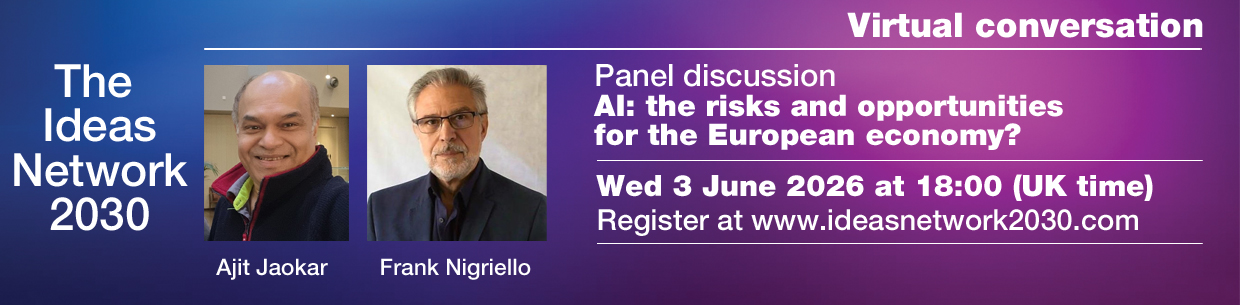
Wednesday 6 May 2026 at 6pm (UK time)
VIRTUAL CONVERSATION
AI: the risks and opportunities for the European economy?
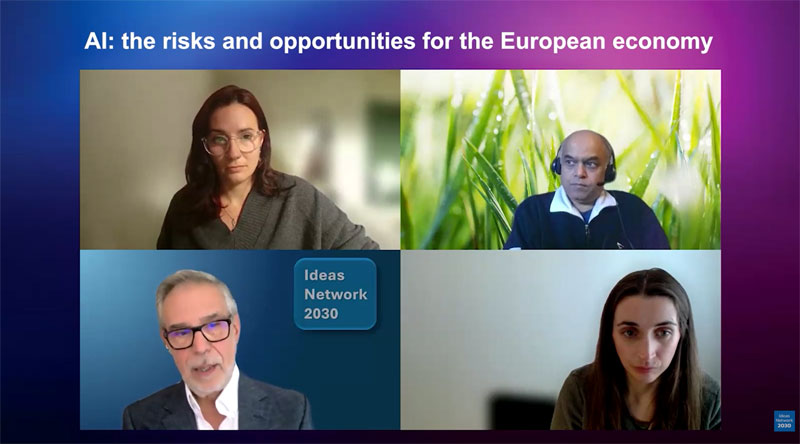
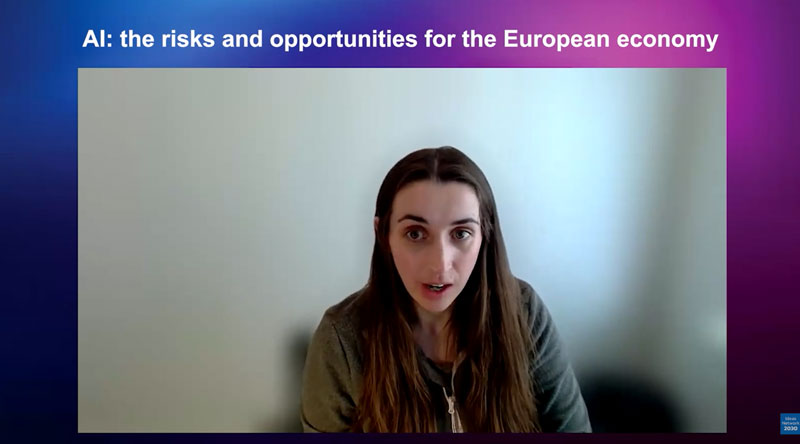
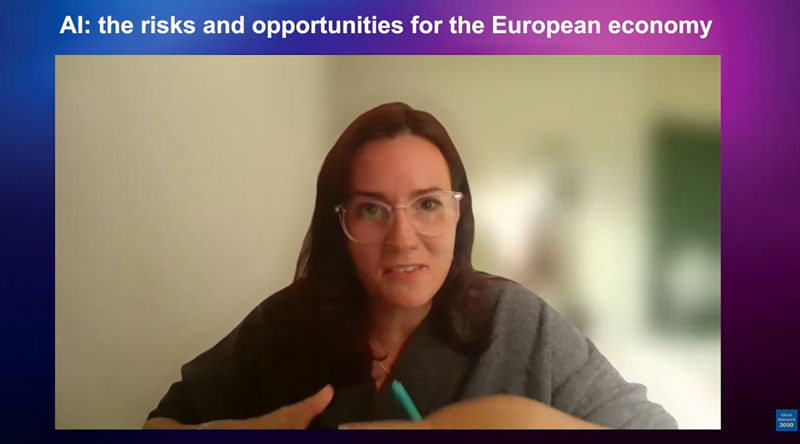
With Ajit Jaokar, University of Oxford, moderated by Frank Nigriello, joined by Cassie Newbold, Data & AI Analyst, Brabners and Rosie Djurovic, Head of AI at Brabners, who offered their own insights to the conversation.
Scroll down for more information or click below to jump to specific sections
> Introduction
> AI summary of event
> Speakers bios
Introduction to the event
This panel provided an annual stocktake on technological change, focusing on artificial intelligence's evolving impact on European economies and geopolitics.
Artificial Intelligence is being introduced at an accelerating pace into almost all aspects of modern life, promising profound benefits and significant changes. AI is boosting productivity and innovation but also threatens profound worker displacement, with potentially disruptive political ramifications.
Projections for the UK are uncomfortable, with forecasts of millions of jobs being lost by 2035. Firms in AI-exposed sectors have already cut professional employment by 4.5%, AI threatening cognitive work rather than manual labour. But how real are these forecasts when according to American labour market analysis, the AI revolution is not that rapid?
Further reading: Guidelines published by the Anthropic Institute
AI summary of the discussions
1. We've entered a post-software World
The traditional chain (human to software to system) has been replaced. Humans now interface with AI, which generates software, which generates systems. Software hasn't lost value; it's moved further down the stack. The human is now accountable for the solution, not the code.
This shift explains why SaaS companies are under pressure: AI agents now act as intermediaries between users and software, deciding which tools to deploy.
2. New roles replacing old ones
Three emerging roles dominate the new landscape:
- Platform engineer: manages scale, APIs, and infrastructure
- AI product engineer: combines AI with human development to ship products
- Forward-deployed engineer: the translator between domain expertise and AI systems; the biggest growth opportunity, open to non-technical people
The "forward-deployed" concept extends beyond engineering. Any domain expert who can capture user requirements and rapidly prototype solutions (with tools like Claude or Lovable) fills this role. This creates a new class of builders who were previously locked out.
3. Skills and education
- Formal qualifications matter as signalling mechanisms, not as rigid gatekeepers
- A dance or philosophy degree is no less valid than computer science; AI dramatically lowers the barrier to reskilling into technical domains
- The most important skill: the ability to think for yourself (Orwell vs. Huxley framing: the risk isn't control, it's passive consumption)
- UK government's free AI Skills Hub is a starting point, but far more is needed
- Children should be taught responsible AI use from primary school upward; banning it is futile and counterproductive
- Local/on-device AI models offer a safer, governed approach for schools and families compared to cloud tools
4. Governance is the bottleneck
Only ~5% of AI systems have moved beyond prototype into production. The primary blocker is missing governance, not missing capability.
Effective enterprise AI governance = value + safety + compliance + trustworthiness + accountability + controls. Organisations that internalise this framework won't need external regulators to tell them what to do.
Hallucinations are reduced through three levers: well-managed data, educated people, and clear operational frameworks. Regulation alone is not sufficient.
5. The EU AI Act: Benchmark or brake?
All three panellists were sceptical. The Act is too restrictive for startups and limits the open, abundance-driven innovation that AI enables. With the US providing most AI infrastructure and China actively incentivising development, the UK risks falling behind without sovereign AI capability.
However, some regulation is better than none. As one panellist put it: "responsibility without regulation is living on a hope and prayer."
The UK's strength lies in deep tech and fundamental science (UCL and Cambridge spin-outs attracting billion-dollar seed rounds), not in competing on social-media-scale platforms. Major AI companies including Google, OpenAI, Anthropic, and Microsoft are choosing to be in the UK, which counts for something.
6. US and China competition, and Open Source
China's "DeepSeek approach" (iterative engineering improvements rather than raw scale) is proving effective and is accelerating the broader open-source movement. Open sourcing benefits everyone: companies that share receive back.
The real risk of US-China competition isn't AGI race dynamics. It's a widening competency gap between nations. Sovereign AI capability (skills, knowledge, infrastructure) matters more than GPU counts.
AGI may or may not arrive, but the journey to it is where the opportunity sits, right now.
7. Jobs: Fear vs. reality
US labour data shows most recent layoffs are post-COVID restructuring, not direct AI displacement. The panel broadly agreed: the fear is media-amplified, but not entirely unfounded.
The real and immediate impact is on junior roles and new entrants. Tasks like dashboards, data visualisation, and code generation are increasingly AI-native. The bigger issue is that roles are changing faster than people are being trained to adapt, and that uncertainty is what drives fear, not redundancy itself.
Watch videos
Speakers' bios
Ajit Jaokar is a dedicated leader and teacher in Artificial Intelligence (AI), with a strong background in AI for Cyber-Physical Systems, research, entrepreneurship, and academia. Currently, he serves as the Course Director for several AI programs at the University of Oxford and is a Visiting Fellow in Engineering Sciences at the University of Oxford. His work is rooted in the interdisciplinary aspects of AI, such as AI integration with Digital Twins and Cybersecurity.
His courses have also been delivered at prestigious institutions, including the London School of Economics (LSE), Universidad Politécnica de Madrid (UPM), and as part of The Future Society at the Harvard Kennedy School of Government.
As an Advisory AI Engineer, Ajit specialises in developing innovative, early-stage AI prototypes for complex applications. His work focuses on leveraging interdisciplinary approaches to solve real-world challenges using AI technologies. Ajit has shared his expertise on technology and AI with several high-profile platforms, including the World Economic Forum, Capitol Hill/White House, and the European Parliament. He also consults at senior advisory levels to companies.
Frank Nigriello is a writer, editor, and management consultant with a strong background in working with both ‘blue chip’ companies and SMEs. He was until recently Director of Corporate Affairs for Unipart, the global manufacturing, logistics and consultancy group headquartered in Oxford, Chairman of Oxfordshire Business First and chair of the B4 business network.
In 2014, he was named as HRH The Prince of Wales’s Responsible Business Ambassador for the South East. He is a founder member of IN2030. Frank began his career as a journalist, first in New York then in the UK. He joined IBM UK and later joined Barclays PLC as its first Head of Organisational Communications. Frank has been chairman of Oxfordshire’s Economic Partnership and chaired the county’s Employment and Skills Board. He was Chair of the South East Advisory Board of Business in the Community and a member of the Oxford Strategic Partnership board.
Cassie Newbold, is a Data & AI Analyst at Brabners. Cassie has developed data, Power Platform and AI solutions across a multitude of sectors. She brings a practitioner's perspective on responsible AI adoption, shaped by hands-on implementation experience and independent work exploring the environmental cost of AI at scale. She is particularly focused on the gap between AI's commercial promise and the governance, trust, and ecological obligations that responsible deployment demands.
Rosie Djurovic is Head of AI at Brabners, a Top 100 law firm, where she leads AI strategy across the human, cultural and technical dimensions of AI transformation. With a technical background spanning Ed-Tech, product development and consulting, Rosie brings a hands-on approach to AI adoption grounded in both practice and research.
She is an AI Researcher with Erdos Research, focusing on AI literacy and reskilling, and writes about human-AI augmentation at djuroai.com - exploring what it really means to build and work alongside intelligent systems.
Rosie is passionate about responsible AI and tech for good and is particularly interested in projects that use AI to solve real problems for communities and the environment.