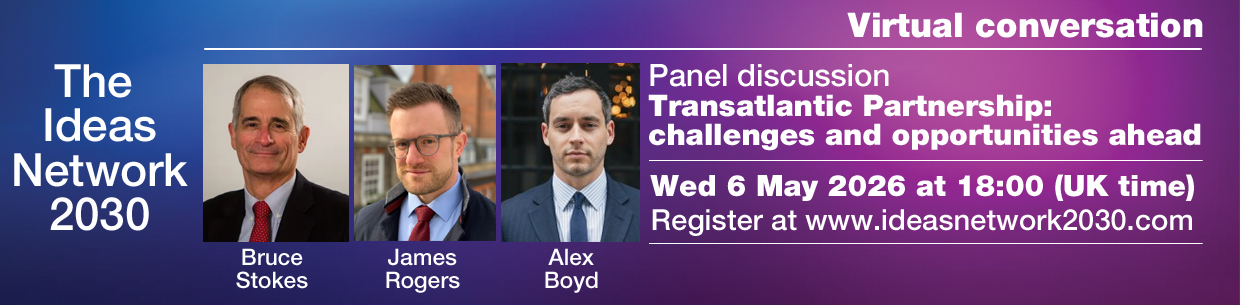
Wednesday 6 May 2026 at 6pm (UK time)
VIRTUAL CONVERSATION
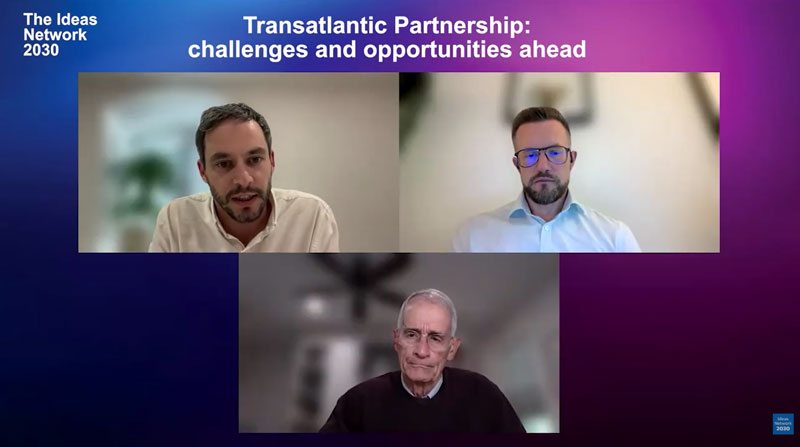
Transatlantic Partnership: challenges and opportunities ahead
With Bruce Stokes, visiting senior fellow at the German Marshall Fund of the United States, plus James Rogers, Co-Founder (Research), Council on Geostrategy, and moderated by Alex Boyd
Scroll down for more information or click below to jump to specific sections
> Introduction
> AI summary of event
> Speakers bios
Introduction to the event
One year into the return of a Trump presidency, this panel will assess the tangible political and strategic consequences that have reshaped transatlantic relations. It will examine how documented shifts in US policy have transformed established frameworks for cooperation across trade, defence, and technology. The recent publication of both the National Security Strategy (NSS) and the National Defense Strategy (NDS) clearly show that Europe must now take responsiblity for its conventional defence.
The discussion will explore how the UK, EU, and US are navigating this phase in their relationship and assess whether shared interests have proven sufficient to sustain meaningful cooperation amid increasing geopolitical competition. Key topics will include the actual response to China's continued rise; how NATO and collective security arrangements have evolved in practice; concrete changes to transatlantic trade relationships, and the divergent approaches to digital governance and industrial policy that have emerged.
The panel will finally reflect on what role the UK and Europe have actually played in attempting to shape a coherent Western response to rapid global changes and what lessons can be drawn for the long-term future of the transatlantic alliance in the 2030’s.
- With the NATO Summit decision last June for members to meet a 5% GDP target by 2035, how is the transatlantic alliance adapting to continue to operate effectively ? How can the UK, EU and US stay aligned on defence, technology and trade in the years ahead?
- Will the Trump presidency focus for US disengagement in Europe be a temporary phenomenon , or is this a longer term trend ? What is the current outlook for the Midterm elections in November?
- Now that the European Parliament has approved the EU US Trade deal b a large margin, is there room for transatlantic cooperation to improve?
r
AI summary of the event
American public opinion and domestic politics
Economic concerns dominate the American public's priorities, with foreign policy and trade barely registering. On the Iran War, roughly six in ten Americans hold negative views, though the split is sharply partisan — nine in ten Democrats oppose it versus eight in ten Republicans in favour. On Trump's tariffs, roughly two-thirds of Americans disapprove, again driven by Democrats and independents, though three-quarters of Republicans are supportive.
Looking ahead to the midterm Congressional elections, Trump's approval ratings are historically low, and the generic ballot favours Democrats by around six points. History also works against the Republicans — the president's party has gained House seats in a midterm only six times in 164 years. However, the Senate picture is harder for Democrats, who would need to pick up four seats in a map offering very few competitive races.
Structural shifts in the Transatlantic relationship
Changes in the transatlantic relationship predate Trump and reflect longer-term structural trends. Every US administration since Bush II has pressed Europe to do more on defence. The relative economic divergence between the US and Europe over the past two decades — with the US surging ahead in GDP per capita and dominating next-generation technologies such as AI — has given Washington a new degree of autonomy and assertiveness.
The centre of gravity in US strategic thinking has shifted decisively toward the Indo-Pacific and the challenge of China, with Europe declining in relative geopolitical weight. The US is also withdrawing from the post-war multilateral institutional architecture in favour of a more transactional approach. Specific friction points noted included the UK's handling of the British Indian Ocean Territory, disagreements over Iran policy, and the extraordinary episode over Greenland and Denmark.
US decline or continued dominance?
One view framed the US as being in relative decline, noting that the mindset of the foreign policy establishment was shaped in a different era. A contrasting perspective argued the US remains dominant in AI compute, global naval reach, basing networks, and its share of world GDP — even as its manufacturing share has fallen. Both perspectives agreed China is the only power to have genuinely closed the gap in certain respects, though the US still holds commanding advantages overall.
Audience Q&A highlights
Democrats and foreign policy bandwidth: Even if Democrats win Congress and eventually the White House, restoring transatlantic relations is likely to be a low priority given domestic pressures and the likelihood of major investigations into the Trump administration consuming political energy.
Tariff continuity: Many Trump-era tariffs, particularly those on China, are likely to persist under any future administration given strong public anti-China sentiment and lobbying from protected industries.
Day-to-day UK–US cooperation: The bilateral relationship remains extremely deep — anchored in nuclear cooperation, Five Eyes intelligence sharing, and AUKUS — and largely insulated from political turbulence. The King's visit to Washington was cited as illustrative of this stabilising dynamic. Trump's personal affinity for the British monarchy, and the practical advantage of a shared language, also act as buffers.
European investment in the US: Much European investment in America is commercially rational regardless of politics, though questions were raised about whether politically coerced investments would materialise before a potential change of administration makes them unnecessary.
Closing reflections: Where are the opportunities?
The discussion converged on the need to rebuild a shared vision among leading democracies — comparable to the liberal democratic offer that outcompeted the Soviet model during the Cold War — as the essential response to China's increasingly attractive model of authoritarian capitalism.
The prerequisite, currently absent in the US, is an acceptance that the problems both sides face — China, climate change, renewed Russian aggression, migration pressures from the Global South — are too large for any single power to manage alone. Concern was expressed that current political leadership on neither side of the Atlantic appears equipped to construct this new shared framework.
Watch videos
Speakers' bios
Bruce Stokes is a visiting senior fellow at the German Marshall Fund of the United States in Washington DC, a non-resident fellow at Chatham House in London and a member of the board of the Transatlantic Policy Network.
He has been the director of international economic polling at the Pew Research Center, where he helped design their global public opinion research; a senior fellow at both the German Marshall Fund and the Council of Foreign Relation; and the international economics correspondent for the National Journal, a Washington public policy magazine.
He is a graduate of the School of Foreign Service at Georgetown University, the School for Advanced International Studies at Johns Hopkins University and attended the School of Journalism at Columbia University.
James Rogers is Co-founder (Research) at the Council on Geostrategy, where he specialises in British strategic policy in the Euro-Atlantic and Indo-Pacific, and net assessment. He has pioneered work on Euro-Atlantic and Indo-Pacific connectivities, as well as net assessment and strategic advantage. Previously, he held a range of positions including at the Baltic Defence College in Estonia and the European Union Institute for Security Studies in France. He is also a Visiting Fellow at the Durham Institute of Research, Development and Invention (DIRDI).
James has given oral evidence at the Foreign Affairs, Defence, and International Development committees in the House of Commons, and the Defence and International Relations and European Affairs committees in the House of Lords. He consults regularly with the Cabinet Office, Ministry of Defence, and the Foreign, Commonwealth and Development Office on foreign affairs and national security. He holds an MPhil in Contemporary European Studies from the University of Cambridge and an award-winning BSc Econ (Hons.) in International Politics and Strategic Studies from the University of Wales, Aberystwyth.
James has appeared on Times Radio, Sky News and LBC Radio and has written for Times Red Box, the Kyiv Independent, The Spectator and CityAM. He has also been quoted in Newsweek and numerous other publications.
Alex Boyd is a Director at Strand Partners, a consultancy based in London. He formerly worked as a senior civil servant and special adviser in UK Government as well as in the European Parliament. Alex is also a Director of the Ideas Network 2030.